Racial and Ethnic Disparities in Non-Fatal Self-Inflicted Firearm Injuries Among Adults in the United States, 2000-2021
Abstract
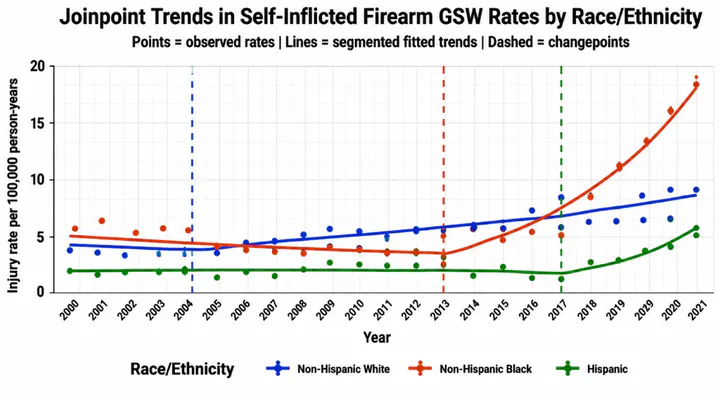
Nonfatal self-inflicted firearm injuries represent an important and understudied public health concern in the United States. We analyzed nationally representative data from the National Electronic Injury Surveillance System–Firearm Injury Surveillance Study (NEISS-FISS), 2000–2021, to characterize nonfatal self-inflicted firearm injuries among U.S. adults aged 18–64 years. Emergency department (ED) narratives were combined using text mining and an elastic net (LASSO) classification model to augment structured surveillance data. Among 7,362 unweighted cases (representing approximately 260,602 ED visits, 58% were classified as probable unintentional discharges, whereas approximately 10% were probable suicide attempts. Among cases with complete race and ethnicity data, Non-Hispanic White (NHW; 69.2%), Non-Hispanic Black (NHB; 23.2%), and Hispanic (7.6%) individuals comprised the primary analytic groups. Narrative analysis substantially increased detection of contextual factors, particularly alcohol involvement among Hispanic patients (12.0% to 20.1%). NHB patients had the highest proportion of lower-extremity injuries (51%), while Hispanic patients had the highest prevalence of craniofacial injuries (26%). The LASSO model effectively distinguished terms associated with probable suicide attempts from unintentional firearm discharges based on narrative language. Findings highlight limitations of structured intent coding within NEISS-FISS and demonstrate the value of narrative for improving characterization of firearm injury circumstances, revealing distinct racial and ethnic group patterns, to inform more tailored prevention strategies.
Plain-Language Summary
This study analyzes nonfatal, self-inflicted firearm injuries in the United States over a 22-year period (2000-2021) using the National Electronic Injury Surveillance System (NEISS-FISS). Because structured database codes often fail to capture the context or intent behind a self-inflicted discharge, the research team used text mining and a machine learning (LASSO) classification model to analyze the unstructured clinical narratives written by emergency department staff.
The results show that while 58% of visits were likely unintentional discharges (accidents), 10% were probable suicide attempts. The narrative text mining revealed distinct, racially disparate patterns of injury: Non-Hispanic Black patients suffered the highest proportion of lower-extremity injuries (51%), while Hispanic patients had the highest rates of craniofacial injuries (26%) and a significant association with alcohol involvement (increasing from 12% in coded data to 20% in narrative data). This highlights the value of using natural language processing to analyze emergency department notes for better injury prevention and public health surveillance.

Dr. Gia Elise Barboza-Salerno
Director
I am an interdisciplinary scholar whose research integrates law, public health, social work, and advanced statistics to study childhood adversity, violence-related harm, and neighborhood-level inequities. I lead the ISSUES Lab at Ohio State, translating spatial and legal analysis into policy and practice.
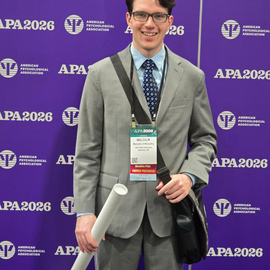
Malcolm McCarthy
Undergraduate Geospatial Analyst
Malcolm is a third-year psychology major with minors in GIS and ASL studies interested in pursuing a clinical psychology PhD.
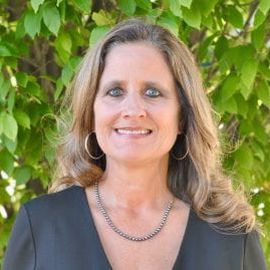
Dr. Amy Watson-Grace
PhD Candidate, Methodologist
Dr. Amy Watson-Grace is a PhD candidate and occupational therapist with advanced pediatric board certification and extensive clinical and leadership experience.
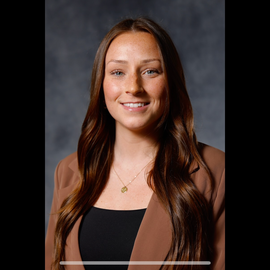
Taylor Harrington
PhD Candidate, Methodologist
Taylor Harrington, MS, is a PhD candidate in Public Health at The Ohio State University. To investigate how multi-level factors shape health behaviors and outcomes, she integrates advanced computational and geospatial methods, including machine learning (e.g., computer vision, random forests, structured topic modeling, text mining) and geospatial modeling (e.g., Bayesian spatial modeling, remote sensing). Through this work, she aims to generate actionable evidence to inform equitable health policy and community-level interventions.
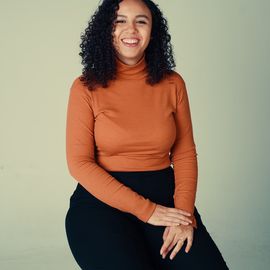
Bruna Atalaya
PhD student
Bruna Atalaya is a Brazilian scholar whose research examines housing inequality, climate-related disasters, and displacement through the lens of racial and spatial justice. She has extensive experience conducting qualitative research and fieldwork in Brazilian favelas and is expanding her expertise in geospatial methods and comparative research beyond Latin America.
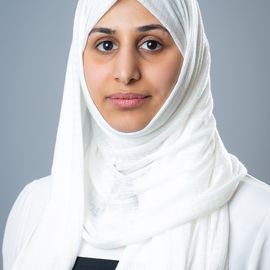
Zahra Alhajjaj
PhD Candidate, Graduate Research Assistant
Zahra Alhajjaj is a PhD candidate in Nursing at The Ohio State University with a background in oncology nursing and clinical practice. Her research focuses on HPV vaccination among Muslim mothers, particularly the role of health beliefs, knowledge, and other factors influencing vaccination decisions.
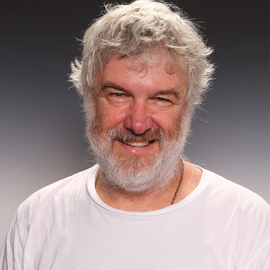
Dr. Keith Warren
Faculty Affiliate
Dr. Keith Warren is a Faculty Affiliate in the ISSUES Lab and an Associate Professor at The Ohio State University.
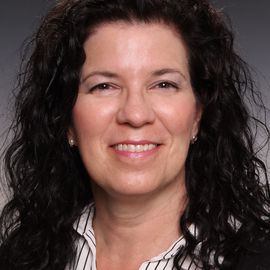
Dr. Karla Shockley McCarthy
Co-Director
Dr. Karla Shockley, PhD, LMSW, TRCC, FSW, is a Principal Investigator and Senior Research Consultant at the Ohio Colleges of Medicine Government Resource Center, where she leads applied health services and population health research. She uses a collaborative team approach to design and execute mixed methods studies, develops survey instrumentation, oversees qualitative and quantitative analyses, and employs various dissemination methods. Her work centers on translating complex data into actionable insights that inform public health.