A Multilevel Analysis of Individual and Community Factors Associated With Case Dispositions Following Child Maltreatment Investigations
Abstract
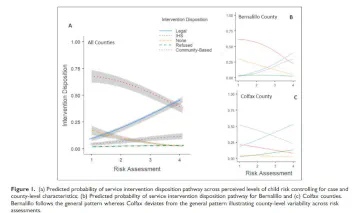
This study investigates how individual case characteristics and county-level social vulnerabilities influence the decisions made by child protective services (CPS) investigators when recommending services for families. Analyzing over 12,000 cases across New Mexico, the study looks at factors such as child age, abuse type, prior history, and county-level deprivation (e.g., housing and transportation deficits). The results show that county-level characteristics significantly influence whether a family receives support services. Even when families present with similar risk levels, those living in counties with higher structural vulnerabilities are subject to different service disposition outcomes. The findings highlight the need for standardized decision-making tools to ensure equitable treatment and service distribution across different geographic regions.
Plain-Language Summary
This study investigates how individual case characteristics and county-level social vulnerabilities influence the decisions made by child protective services (CPS) investigators when recommending services for families. Analyzing over 12,000 cases across New Mexico, the study looks at factors such as child age, abuse type, prior history, and county-level deprivation (e.g., housing and transportation deficits).
The results show that county-level characteristics significantly influence whether a family receives support services. Even when families present with similar risk levels, those living in counties with higher structural vulnerabilities are subject to different service disposition outcomes. The findings highlight the need for standardized decision-making tools to ensure equitable treatment and service distribution across different geographic regions.

Dr. Gia Elise Barboza-Salerno
Director
I am an interdisciplinary scholar whose research integrates law, public health, social work, and advanced statistics to study childhood adversity, violence-related harm, and neighborhood-level inequities. I lead the ISSUES Lab at Ohio State, translating spatial and legal analysis into policy and practice.