Variability and stability in child maltreatment risk across time and space and its association with neighborhood social & housing vulnerability in New Mexico: A bayesian space-time model
Abstract
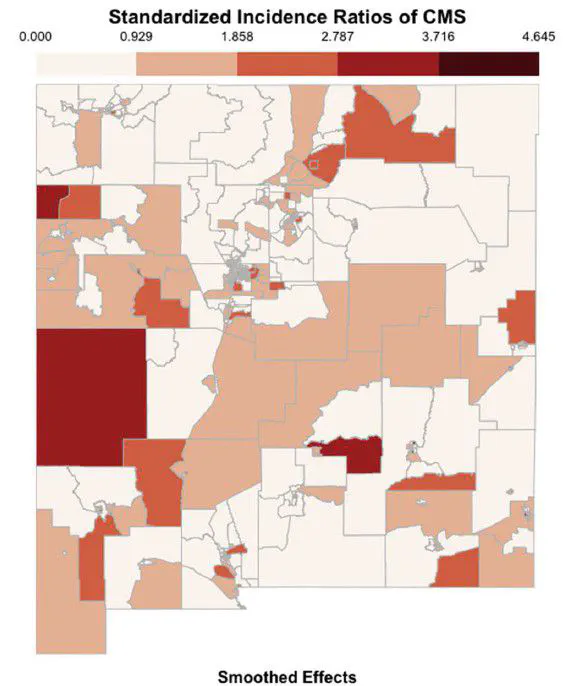
This study examines the geographic and temporal patterns of child abuse and neglect referrals across New Mexico census tracts over a 9-year period. By utilizing Bayesian spatial models, the researchers identified areas with persistently high risk and examined how social and housing vulnerabilities affect maltreatment rates. The results demonstrate that neighborhood deprivation, housing insecurity, and residential instability are strong predictors of substantiated child abuse and neglect. The study highlights the utility of using space-time models to pinpoint communities that require enhanced support services, enabling child welfare agencies to allocate resources more equitably and proactively.
Plain-Language Summary
This study examines the geographic and temporal patterns of child abuse and neglect referrals across New Mexico census tracts over a 9-year period. By utilizing Bayesian spatial models, the researchers identified areas with persistently high risk and examined how social and housing vulnerabilities affect maltreatment rates.
The results demonstrate that neighborhood deprivation, housing insecurity, and residential instability are strong predictors of substantiated child abuse and neglect. The study highlights the utility of using space-time models to pinpoint communities that require enhanced support services, enabling child welfare agencies to allocate resources more equitably and proactively.

Dr. Gia Elise Barboza-Salerno
Director
I am an interdisciplinary scholar whose research integrates law, public health, social work, and advanced statistics to study childhood adversity, violence-related harm, and neighborhood-level inequities. I lead the ISSUES Lab at Ohio State, translating spatial and legal analysis into policy and practice.