An examination of the effect of area-level characteristics on juvenile justice and child welfare referrals using multivariate Bayesian spatial modeling
Abstract
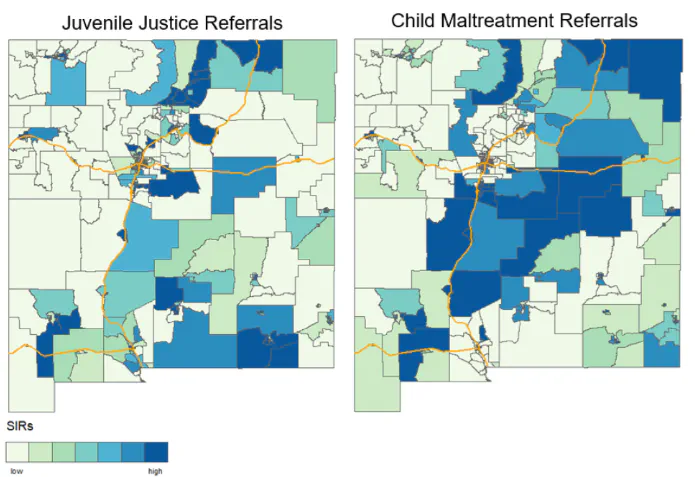
This study examined the spatial overlap of child welfare and juvenile justice involvement using multivariate Bayesian spatial modeling. Results show a significant positive association between juvenile justice and child maltreatment referrals across neighborhoods. After adjusting for residential instability, immigrant concentration, and residential segregation, children in the least deprived 20% of neighborhoods were 95.2% and 55.5% less likely to be referred to child welfare or justice systems, respectively, compared to those in the most deprived 20%.
Plain-Language Summary
This study examined the spatial overlap of child welfare and juvenile justice involvement using multivariate Bayesian spatial modeling. Results show a significant positive association between juvenile justice and child maltreatment referrals across neighborhoods. After adjusting for residential instability, immigrant concentration, and residential segregation, children in the least deprived 20% of neighborhoods were 95.2% and 55.5% less likely to be referred to child welfare or justice systems, respectively, compared to those in the most deprived 20%.

Dr. Gia Elise Barboza-Salerno
Director
I am an interdisciplinary scholar whose research integrates law, public health, social work, and advanced statistics to study childhood adversity, violence-related harm, and neighborhood-level inequities. I lead the ISSUES Lab at Ohio State, translating spatial and legal analysis into policy and practice.