No Bright Line: How AI-driven Technology Blurs Legal Boundaries Between Prevention and Punishment in Family Regulation
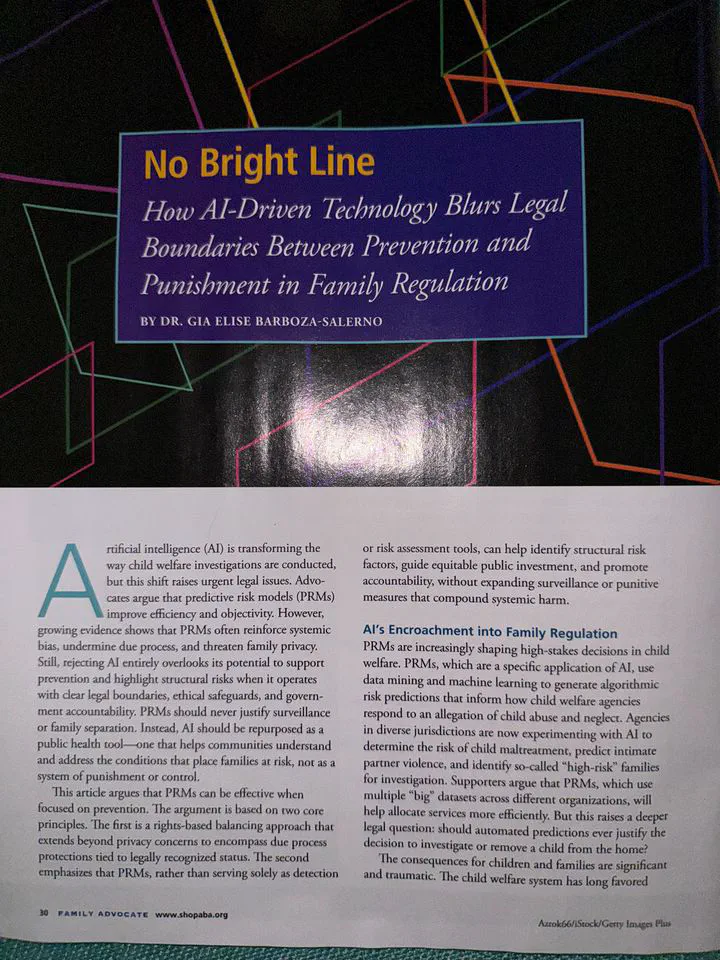
This new article by Dr. Gia E. Barboza-Salerno argues that Predictive Risk Models (PRMs) can be effective when focused on prevention. The argument is grounded in two core principles. The first is a rights-based balancing approach that extends beyond privacy concerns to encompass due process protections tied to legally recognized status.
The second emphasizes that PRMs, rather than serving solely as detection or risk assessment tools, can help identify structural risk factors, guide equitable public investment, and promote accountability, without expanding surveillance or punitive measures that compound systemic harm.
Together, these principles challenge the false dichotomy between prevention and punishment that underlies much of AI’s deployment in family regulation. By integrating a legal and ethical framework rooted in rights protection and structural accountability, the article redefines what responsible and justice-oriented AI looks like in the context of family welfare systems.
Read the full article here: “Barboza-Salerno, G. E. (2025). No bright line: How AI-driven technology blurs legal boundaries between prevention and punishment in family regulation. Family Advocate, 47(2), 00–00. American Bar Association.”

Dr. Gia Elise Barboza-Salerno
Director
I am an interdisciplinary scholar whose research integrates law, public health, social work, and advanced statistics to study childhood adversity, violence-related harm, and neighborhood-level inequities. I lead the ISSUES Lab at Ohio State, translating spatial and legal analysis into policy and practice.