IPR Seminar Series: Accessibility to Abortion Services, Maternal Vulnerability, and Birth Outcomes
Abstract
Does spatial accessibility to abortion care intersect with maternal vulnerability to shape adverse birth outcomes? This study examines whether spatial constraints on abortion access align with community-level maternal vulnerability and how these structural conditions are associated with adverse birth outcomes using a novel Maternal Vulnerability Index (MVI) and GIS-based transportation network modeling.
Dr. Gia Barboza-Salerno will present at the Institute for Population Research (IPR) Seminar Series on Tuesday, March 10, 2026.
Presentation Details
Title: Accessibility to Abortion Services, Maternal Vulnerability, and Birth Outcomes
Date: Tuesday, March 10, 2026
Time: 12:30 - 1:30 PM
Location: Townshend Hall, room 038, 1885 Neil Ave Mall and Zoom
Registration: Register for Zoom access
Abstract
Does spatial accessibility to abortion care intersect with maternal vulnerability to shape adverse birth outcomes? In the post-Dobbs landscape, access to abortion services has become increasingly uneven, with substantial geographic barriers emerging across large portions of the state. This study examines whether spatial constraints on abortion access align with community-level maternal vulnerability and how these structural conditions are associated with adverse birth outcomes.
The study uses a novel Maternal Vulnerability Index (MVI), a validated, census-tract-level measure that captures multidimensional drivers of poor maternal health, including:
- Healthcare access
- Reproductive health resources
- Physical and mental health
- Environmental conditions
- Socioeconomic disadvantage
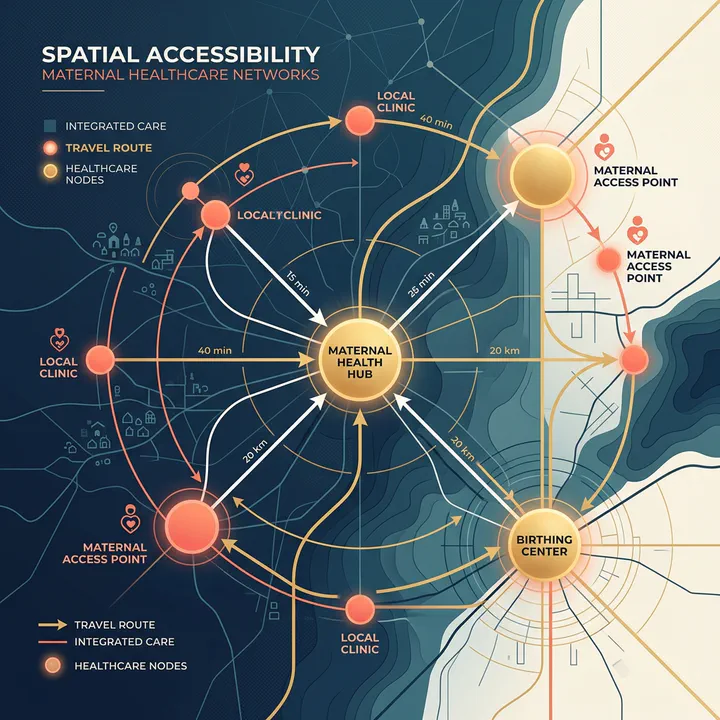
Geographic information systems (GIS) and multimodal transportation network modeling are used to quantify travel burden, service deserts, and spatial accessibility to abortion. These spatial access measures are then linked to adverse birth outcomes (e.g., preterm birth), to assess whether communities facing greater abortion access constraints experience elevated perinatal risk.
By situating abortion accessibility within a comprehensive measure of maternal vulnerability, this study highlights how geographic and structural inequities in reproductive healthcare access may contribute to persistent disparities in maternal and infant health.

Dr. Gia Elise Barboza-Salerno
Director
I am an interdisciplinary scholar whose research integrates law, public health, social work, and advanced statistics to study childhood adversity, violence-related harm, and neighborhood-level inequities. I lead the ISSUES Lab at Ohio State, translating spatial and legal analysis into policy and practice.

Taylor Harrington
PhD Candidate, Methodologist
Taylor Harrington, MS, is a PhD candidate in Public Health at The Ohio State University. To investigate how multi-level factors shape health behaviors and outcomes, she integrates advanced computational and geospatial methods, including machine learning (e.g., computer vision, random forests, structured topic modeling, text mining) and geospatial modeling (e.g., Bayesian spatial modeling, remote sensing). Through this work, she aims to generate actionable evidence to inform equitable health policy and community-level interventions.