Predicting harsh school discipline in Albuquerque Public Schools: A machine learning analysis with temporal validation
Abstract
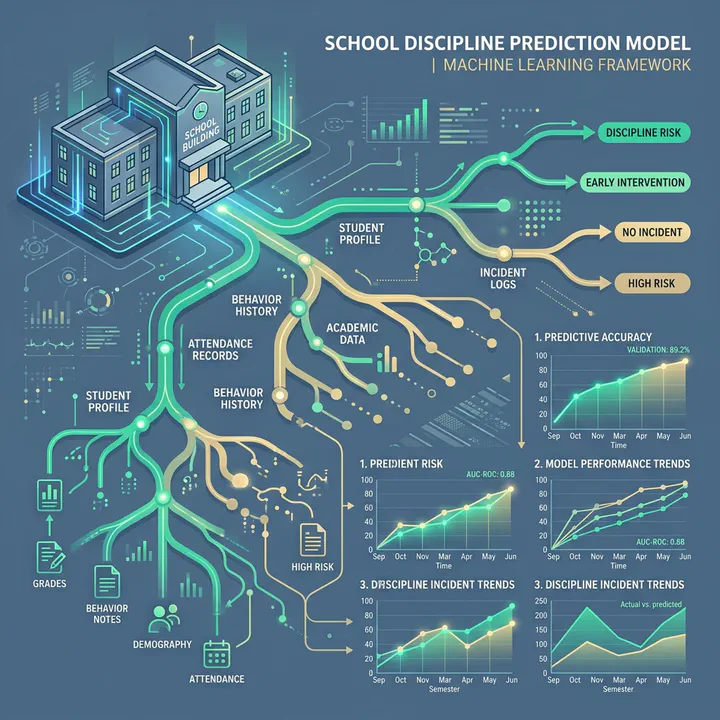
Harsh discipline disproportionately impacts students of color and those experiencing poverty. Few studies examine the most important predictors of school harsh discipline among Native Americans using machine learning algorithms. Using data from Albuquerque Public Schools (APS), we conducted logistic regression, pruned decision trees, random forest plots, and support vector machines to predict harsh discipline outcomes. Models were evaluated using two validation strategies: a stratified 70/30 split within the 2019–20 sample and a temporal holdout in which models trained on 2019–20 data were tested on the entirely out-of-sample 2021–22 data. Results indicated that infraction severity was the dominant predictor across all models and both validated strategies. After controlling for infraction severity, Black students (OR = 1.31, p = .027) and Hispanic/Native American students (OR = 1.24, p = .001) experienced significantly higher odds of harsh discipline relative to White students. Racial disparities were most profound for moderate-severity infractions (Tier 2), where administrative discretion is greatest. All models demonstrated accuracy in the temporal validation (F1 = .783–.786) with approximately 80% recall for harsh outcomes. Results indicate that disparities are not fully explained by the severity of conduct alone.
Session: Public Health Social Work Perspectives on Health and Well-Being Across the Lifespan
Program: Public Health Social Work
Date: Monday, November 2, 2026 | 8:30 AM – 10:00 AM

Dr. Gia Elise Barboza-Salerno
Director
I am an interdisciplinary scholar whose research integrates law, public health, social work, and advanced statistics to study childhood adversity, violence-related harm, and neighborhood-level inequities. I lead the ISSUES Lab at Ohio State, translating spatial and legal analysis into policy and practice.