Extreme heat and suicide risk among older adults: A longitudinal time-series analysis in an urban U.S. setting
Abstract
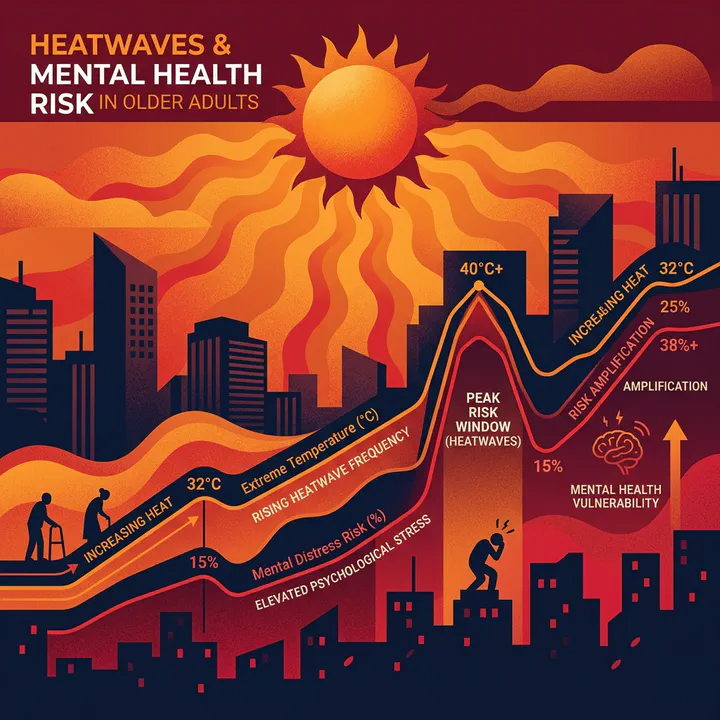
Climate change is increasing the frequency, intensity, and duration of extreme heat events, with important implications for population mental health. Older adults are disproportionately affected by heat-related risks due to physiological vulnerability, social isolation, and limited adaptive capacity, yet suicide outcomes remain underexamined within climate–mental health research. We conducted an ecological longitudinal time-series study of suicide mortality among adults aged ≥65 years in Chicago, Illinois, from 2016–2024. Daily suicide deaths were linked to ambient temperature data to identify extreme heat events, defined as temperatures exceeding the 75th percentile threshold. Neighborhood deprivation was measured using area-based indices and linked to decedents’ residential locations. Poisson regression models estimated associations between extreme heat exposure and suicide mortality, incorporating distributed lag structures and adjusting for neighborhood deprivation, decedent demographics, seasonal patterns, and temporal trends. Extreme heat events were associated with a statistically significant increase in suicide mortality among older adults, with the strongest effect observed at a two-day lag. Each 1°C increase above the extreme heat threshold corresponded to an estimated 20% increase in suicide risk. Extreme heat exposure and neighborhood deprivation independently contributed to suicide mortality.
Session: Climate, Culture, and Life-Course Contexts in Mental Health
Program: Mental Health
Date: Monday, November 2, 2026 | 12:30 PM – 1:30 PM
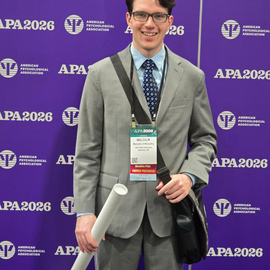
Malcolm McCarthy
Undergraduate Geospatial Analyst
Malcolm is a third-year psychology major with minors in GIS and ASL studies interested in pursuing a clinical psychology PhD.

Dr. Gia Elise Barboza-Salerno
Director
I am an interdisciplinary scholar whose research integrates law, public health, social work, and advanced statistics to study childhood adversity, violence-related harm, and neighborhood-level inequities. I lead the ISSUES Lab at Ohio State, translating spatial and legal analysis into policy and practice.

Taylor Harrington
PhD Candidate, Methodologist
Taylor Harrington, MS, is a PhD candidate in Public Health at The Ohio State University. To investigate how multi-level factors shape health behaviors and outcomes, she integrates advanced computational and geospatial methods, including machine learning (e.g., computer vision, random forests, structured topic modeling, text mining) and geospatial modeling (e.g., Bayesian spatial modeling, remote sensing). Through this work, she aims to generate actionable evidence to inform equitable health policy and community-level interventions.

Olorede Abdulgafar A.
Graduate Research Assistant
My motivation is to advance human rights, social justice, and equity, particularly for vulnerable children and families in underserved and culturally diverse communities locally and internationally. Abdulgafar aims to influence child welfare policy and practice in Nigeria and contribute to the global discourse on social welfare policy and social work practice, driving meaningful impact at both local and international levels.

Dr. Karla Shockley McCarthy
Co-Director
Dr. Karla Shockley, PhD, LMSW, TRCC, FSW, is a Principal Investigator and Senior Research Consultant at the Ohio Colleges of Medicine Government Resource Center, where she leads applied health services and population health research. She uses a collaborative team approach to design and execute mixed methods studies, develops survey instrumentation, oversees qualitative and quantitative analyses, and employs various dissemination methods. Her work centers on translating complex data into actionable insights that inform public health.